Sunday, February 21, 2016

Stan Lee | Jeff Smith | Mike Mignola

Stan Lee


             Born Stanley Martin Leiber on December 28th, 1922,  Stan Lee grew up between New York and Washington Heights, Manhattan, in a small apartment with his parents and younger brother. In his younger years, he did many small jobs, such as writing obituaries and delivering sandwiches, and selling newspaper subsciptions; he was extremely enthusiastic about writing and aspired to create a novel that  would someday become famous. Stan Lee graduated high school early at 16, and that same year, after having been influenced strongly by books and movies throughout early life, became an assistant at Timely Comics. This was also around the time that he shortened his name to "Stan Lee". Years later, TImely Comics evolved into Marvel. In 1961, alongside Jack Kirby, Stan Lee helped create and released Fantastic Four. Lee also worked frequently with Steve Ditko. Alongside these things, Lee has assisted in the inspiration, creation and publishing of multiple other Marvel heroes, such as Spider-Man, the Hulk, Iron Man, and many, many others. Lee is included in the  Will Eisner Award Hall of Fame as of 1994, the Jack Kirby Hall of Fame as of 1995, and received a National Medal of Arts in 2008. Lee has worked as a publisher, writer, and editor, amongst other things, and has continued to create throughout the years. Lee released new work as recently as 2012, aged 90.


Jeff Smith


             Jeff Smith was born February 27th, 1960 in Mckees Rocks, Pennsylvania. Smith, intrigued by the idea of comics right from a young age, felt largely inspired by Peanuts and Carl Barks comcis, and his works with his Bone comics can be dated back to when he was as young as nine years old. For a long time he aspired to do newspaper comics, and while in college, he tried to balance animations and trying to do such; however, newspaper companies continuously tried to buy out his work, so that dream was dropped. Aside from that, for a while, Smith attempted to manage his own company in animation, but that also ended up to be something he was rather unsure of, and in the end he sold the company. Smith wanted control over his own work rather than having somebody take it and do the work for him. He wanted to be able to express his characters as he saw them without modifications or complete changes from outside sources. Neither animation nor newspaper strips would provide for this sort of freedom; and so, for a long time, Smith produced and published his comics, until his wife eventually left her job in order to assist him with sales. Smith's Bone comics are widely regarded as some of the greatest graphic novels of all time, recognized by fans and critics worldwide. The Bone comcis have been completed as of 2004, and another series of his, RASL, has been completed as well as of 2012. Smith's most recent works are on his ongoing comic, Tuki. 


Mike Mignola


            Michael Joseph Mignola was born September 16th, 1960 in Berkeley California, and grew up in Oakland nearby. From a young age, Mignola started drawing monsters for no reason other than that he liked it. He has explained in the past that he had a very strong, memorable moment around age 12, when he read Bram Stoker's Dracula and realized that that genre was exactly the way he wanted to express himself and what he wanted to make a career out of; through stories of the supernatural. His career began around 1982 after graduating from California College of the Arts for Marvel, where he worked on The Hulk ( as an ink artist) and Rocket Racoon (as the penciler), and throughout that time, he began to develop his own style. In the following years (between 1988 and 1990), he worked on larger name projects, such as Cosmic Odessy and Gotham by Gaslight. In 1993, Mignola moved to Dark Horse comics, where he created his comic Hellboy, which is completed, but has a subseries titled Hellboy in Hell. This series is ongoing as of today. Mignola worked as a production designer on the Disney movie Atlantis: The Lost Empire, and was Guillermo Del Toro's Blade II, as well as the Hellboy movie and its sequel, Hellboy 2: The Golden Army.


Works Cited

Groth, Gary. "The Jeff Smith Interview." The Comics Journal. November 21, 2012. Accessed February 20, 2016.                                                                 http://www.tcj.com/the-jeff-smith-interview/.

"Stan Lee Biography." Bio.com. Ed. Biography.com Editors. A&E Networks Television, n.d. Web. 20 Feb. 2016. <http://www.biography.com/people/stan-lee-21101093>.

Mignola, Mike. "Bio." Art of Mike Mignola. Mike Mignola, n.d. Web. 21 Feb. 2016. <http://www.artofmikemignola.com/Bio>.

"Mike Mignola Biography." Notable Biographies. Advameg, Inc., n.d. Web. 21 Feb. 2016. <http://www.notablebiographies.com/news/Li-Ou/Mignola-Mike.html>.


-Lewis Cade

Dale Messick|Jack Kirby| Steve Ditko

Dale Messick


Dale Messick was originally born as Dalia Messick, in April 11, 1906, South Bend, Indiana. Messick was the daughter of Cephas Messick, who was an art teacher, and a sign painter. Like her mother, Messick had an interest in art and drawing, and was naturally talented in such fields. Messick also helped her mother sew and design, and put hats together, which started Messick’s fascination with fashion, which became apparent in her Brenda Starr Reporter comics. However, even through Messick was artistically skilled, she struggled at a young age with school, having to repeat the third and eight grade of her school career. She barely made it through high school, only staying to graduate because her parents encouraged her to do so. Later, Messick studied at the Art Institute of Chicago, however, she shortened her studies to pursue a career as a professional artist. Her first professional job was as a greetings card designer. Her salary was greatly reduced by her boss due to the Great Depression taking place at that time. This cut in pay influenced her decision to quit. Being the main and only income for her family at that time, Messick moved to New York to find a new job, landing another job as a greetings card designer with much higher pay. However, Messick at this time was also putting together her first comic portfolio. She was hoping to get a job that provided more enjoyment compared to card designing, along with a higher salary. Despite Messick’s talent and quality of her first comic portfolio, she was rejected multiple times by the publisher of The New York Daily News and the head of the Chicago tribune-New York Syndicate, Joseph M. Patterson, who was very disapproving of women in the workforce. However, Mollie Slott, Patterson’s secretary, recovered Messick’s portfolio submission that Patterson threw away, telling her to make certain small changes in her work in order to get published. Messick took Mollie’s advice and changed the minor details of her work and resubmitted it. Not long afterwards, Patterson finally approved Messick’s new work, first debuting Brenda Starr Reporter on June 30, 1940, which quickly became one of the most iconic comics of its time.

Jack Kirby


Jack Kirby was born August 28,1917 as Jacob Kurtzberg.  He grew up on the Lower East Side of New York where street fighting and self-preservation became a part of everyday life.  He is a self-taught artist that captured techniques of drawing from anyone and everywhere he could.  He studied Alex Raymond’s Flash Gordon comic strip and adapted his techniques not styles and made them his own.  He shortened his name to Jack Kirby.  Kirby always had a love of stories and was drawn to comics at an early age.   Kirby’s style of drawing was not to simulate reality but to tell great stories.  His figure drawings depict figures in action.  After working several jobs as an animation and comic illustrator, Kirby started working with Joe Simon.  This partnership lasted for years and produced Captain America.  Kirby worked at Detective Comics (DC) and after World War II, Kirby eventually started working at Marvel Comics.  Kirby and head editor, Stan Lee, created the first Fantastic Four in 1961.  Kirby and Lee developed an interesting way of developing their stories and characters.  Both men would talk about an idea, then Kirby would start to draw the story.  Lee would just add some dialogue and editing.  As Kirby’s work pace slowed down, he was able to improve on his detail.  His comic, Thor, is known for the detailed costumes and majestic landscaping.  Kirby left Marvel in 1970 and went to work again at DC.  In 1975, Kirby returned to Marvel to create the Silver Surfer with Lee.  Kirby passed away on February 6, 1994.  His work and creations are legendary and will live on forever.


Steve Ditko


Steve Ditko was born on November 2, 1927 in Johnstown, PA.  Ditko attended Cartoonists and Illustrators School in New York.  He started his professional illustrator career in 1953 for Charlton Comics.  Ditko started working at Marvel Comics in the early 60s.  It was here that Ditko and Stan Lee created Spider-Man and Doctor Strange.  Ditko also did work on The Incredible Hulk.  Ditko has a unique style and technique.  His landscapes are surreal, very detailed and his characters express mood and anxiety.  After several years at Marvel, Ditko and Lee had a falling out.  Ditko moved to DC Comics where he was granted more freedom to express his personal philosophy.  In his work on The Question and Killjoy, Ditko was inspired by Ayn Rand and Aristotle, the Greek philosopher.  In his creation of Dr. A, Ditko took a controversial position against criminals.  This caused some loss of the fan base but the comic continued until the end of the 70s.  It was revived later on without Ditko in 2000.  Ditko created Shade, the Changing Man that eventually became one of DC longest running comics in the DC vertigo series.  Ditko is a very private man and has not granted an interview since the 60s.  His contribution to comic illustration is also legendary.


Works Cited

Henderson, Ashyia N. "Dale Messick Biography." Story. Accessed February 20, 2016. http://www.notablebiographies.com/newsmakers2/2006-Le-Ra/Messick-Dale.html.

  "Jack Kirby (Earth-1218)." Marvel Database. N.p., n.d. Web. 19 Feb. 2016.

           "Steve Ditko." Marvel Database. N.p., n.d. Web. 19 Feb. 2016.


-Nancy Brockert


Saturday, February 20, 2016

Adam Hughes | Terry Dodson | Stanley Lau


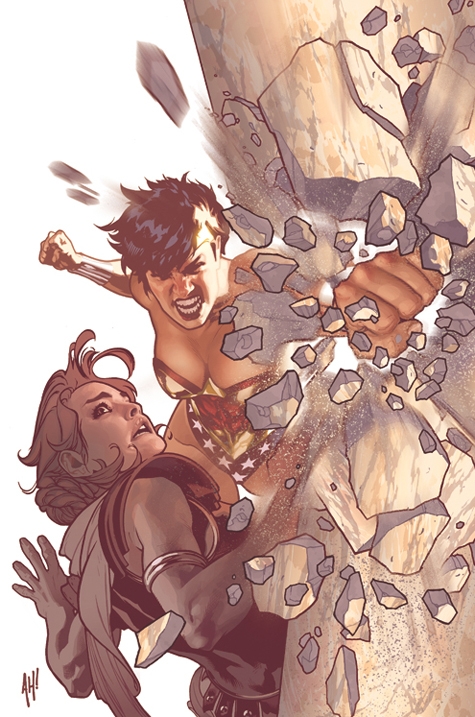
Adam Hughes is a well known and respected cover artist for DC Comics, Marvel, and Dark Horse. His most memorable work is that of his Wonder Woman covers as well as his Catwomen.


Adam Hughes was not always just a cover artist. Back in the 1980’s he did interior work as well as covers until 1990 when he started to do mainly cover artwork gaining popularity with what is known as “good girl art”. His lines and rendering are reminiscent of Art Nouveau as well as the 50’s pin up illustrations. Adam Hughes continues his work on mainly covers but as of late has done a few interior pieces for Watchmen. (Allison)

 Sohn, Allison. "Biography." Just Say AH! ::. Web. 20 Feb. 2016. <http://www.justsayah.com/biography/>. 

Terry Dodson has been a professional since 1993. Not  only did he work for the comic industry on titles such as Spider-Man, Wonder Woman, the X-Men, and Harley Quinn, but for Hasbro Mattel, ESPN, and Hanna-Barbera. He and his wife, Rachel, are a duo as he draws out the scene and she inks it. (About)

Much of Dodson's work is also very Nouveau reminiscent, especially in the hair lines and soft way he colors. His women are strong yet curvy ad he usually likes to accentuate their cheekbones. His lines are always very curved and have a subtle thick to thin quality.
 "About Terry Dodson." The Bombshellter -. Web. 20 Feb. 2016. 
 "The Bombshellter - Terry Dodson's Portfolio." The Bombshellter - Terry Dodson's Portfolio. Web. 20 Feb. 2016.

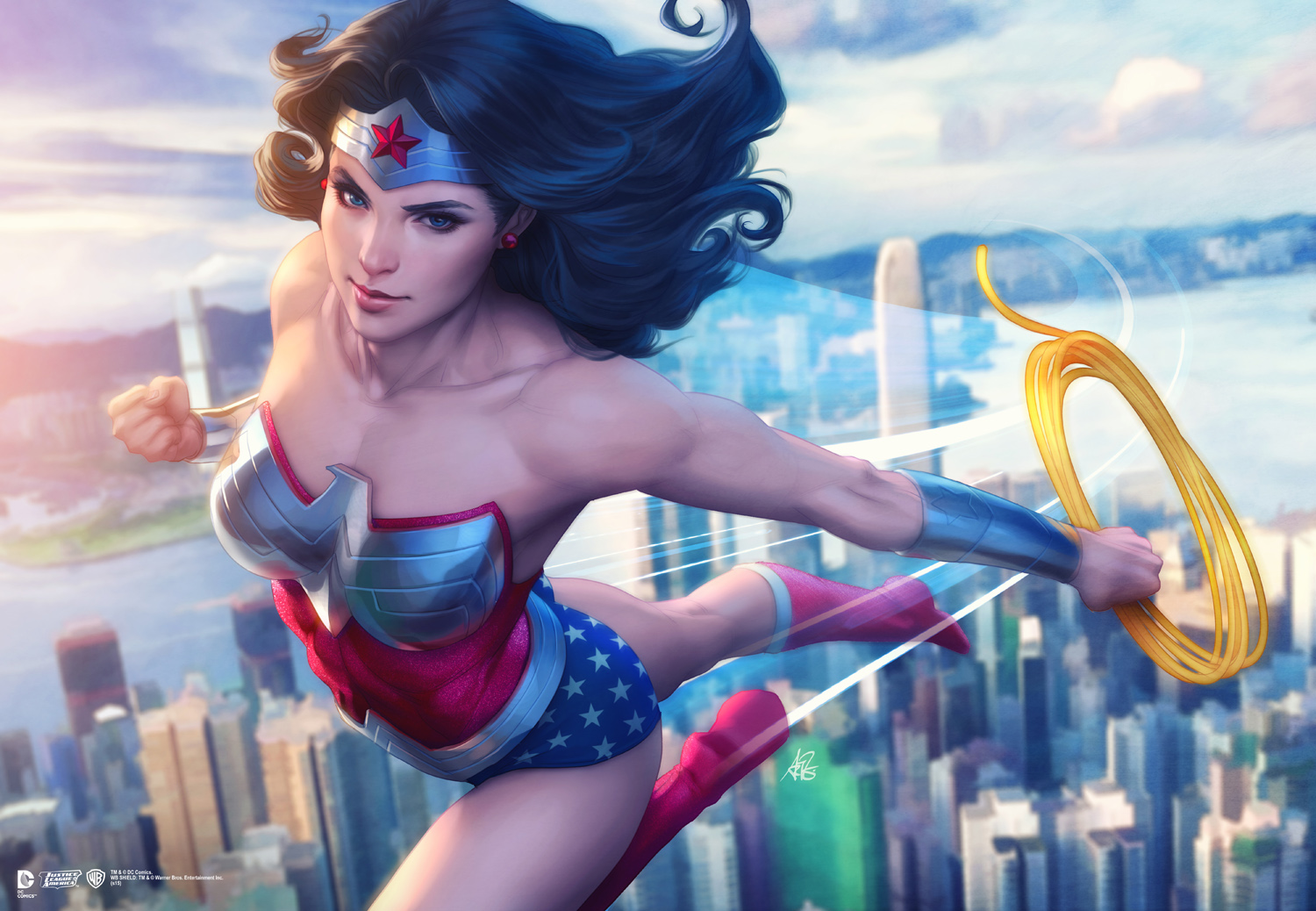
Originating from Hong Kong, Stanley Lau (aka Artgerm) works as an illustrator, designer, and concept artist. His works have graced DC Comics, Marvel, and Capcom. His style is very Eastern influenced with some sprinkles of Western added in. If you've dabbled in online art communities there's a great chance you've seen some of his work, as he's very popular. Currently, Stanley is giving a course in Digital Design & Illustration in Singapore.(Artgerm)
 
Lau's women are usually tall and of athletic build with noticeable makeup such as eye shadow which can be rather rare in others' works. Their hair is flowy and their noses are small and or thin which is a nod to the traditional look of contemporary Eastern art.
 
"Artgerm's DeviantArt Gallery." Artgerm's DeviantArt Gallery. Web. 20 Feb. 2016. 

 "Artgerm™ Stanley Lau (artgerm) on About.me." About.me. Web. 20 Feb. 2016. <https://about.me/artgerm>.